
what is the midnight sun?
There is a question that almost everyone asks when they first hear about the midnight sun and it is not the scientific one. It is not about the axial tilt or the Arctic Circles. It is: What does it actually feel like?
The answer depends on where you are when it happens. From a city, the midnight sun is a curiosity, bright windows and a vague sense of jetlag that doesn't resolve. From the banks of the Torne River in Jukkasjärvi, 200 kilometres above the Arctic Circle, at 1am in late June, it is something else entirely. The river is copper, the trees cast long shadows across the ground. It is warm. No one is going inside. This is what the phenomenon is actually for.


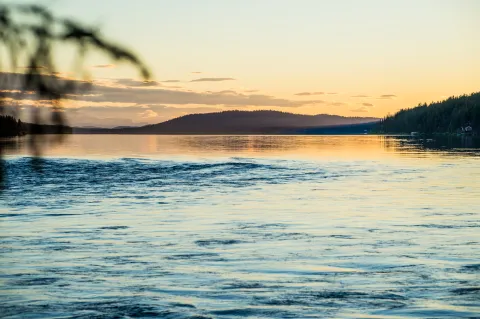
why does the midnight sun occur?
The midnight sun or midnattssolen in Swedish, also called polar day or the nightless night, is a natural phenomenon in which the sun remains above the horizon for twenty four hours or more. It is not continuous bright midday light. It is not a trick of weather. It is an astronomical event, occurring in the same places, on roughly the same dates, every year.
It happens because of how the Earth moves.
Our planet spins on an axis that is tilted at approximately 23.4 degrees relative to the plane of its orbit around the sun. That tilt is the reason for the seasons: As Earth travels around the sun over the course of a year, first one hemisphere and then the other leans towards the light. In summer in the Northern Hemisphere, the North Pole tilts toward the sun. At high enough latitudes, this tilt is so pronounced that even as Earth rotates, even as what should be midnight arrives, the sun never drops below the horizon.
The sun does not sit still during this time. It moves. It traces a low arc across the sky, dipping toward the horizon around midnight and then rising again, never disappearing. The light it casts is warm and directional, the same quality as golden hour at sunset, but sustained. Photographers speak of being in continuous golden hour for weeks. That is not an exaggeration.
Where does the midnight sun occur?
The midnight sun occurs wherever the sun is above the horizon at local midnight during the summer months. The further north of the Arctic Circle you are, the more days you get.
The countries and regions that experience genuine midnight sun and where the sun does not set at all are; Norway, Sweden, Finland, Russia, Iceland (in the far north), Canada (Yukon, Nunavut and Northwest Territories), Greenland and Alaska. The phenomenon also occurs in the Southern Hemisphere, south of the Antarctic Circle, during the southern summer, but there are no permanent settlements there to experience it.
Within this list, the accessibility and character of the experience varies enormously. Remote research stations in Greenland or the Canadian Arctic are not practical destinations. Norway's infrastructure, particularly around Troms and the Lofoten islands, is the most developed. Sweden's Lapland offers something different: Vast, genuinely wild landscapes with a fraction of the tourist traffic of Norway. In the case of Jukkasjärvi, a specific physical place called ICEHOTEL is built around the experience of the Arctic across both its extreme seasons.

The midnight sun versus midnight light - What is the difference?
Here is a distinction worth understanding before you book.
The midnight sun means the sun does not set at all. It remains continuously above the horizon. At its lowest point which occurs around midnight it is still fully visible in the sky. This requires being above the Arctic Circle (approximately 66.5°N latitude). In Jukkasjärvi, at 67°51'N, this lasts fro approximately May 27th to July 14th, which is 47 consecutive days.
The midnight light (sometimes called white nights) is different. The sun drips briefly below the horizon but only just. Not far enough to produce real darkness. The sky stays bright: A deep prolonged, luminous dusk that ever develops into night. This is experienced at latitudes slightly south of the Arctic Circle and in Jukkasjärvi it extends the bright-sky period significantly. Before and after the true midnight sun window, from late April through late August, there is no proper darkness. Locals refer to the full stretch as roughly 100 days without night.
The practical difference is largely one of degree. Both are extraordinary. The midnight sun is the more disorienting, more photographed, more talked about version. The midnight light is quieter and many quests find it equally beautiful.
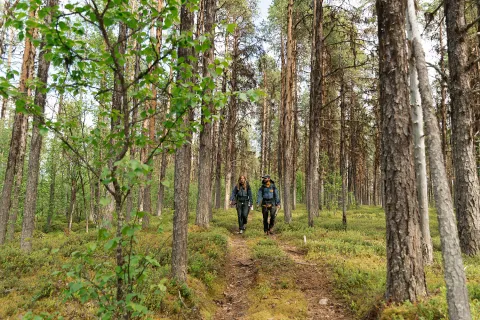
Why the solstice matters
The summer solstice, which falls around June 21st each year, is the astronomical peak of the midnight sun season. It is the moment when the North Pole is tilted at its maximum toward the sun, when the sun reaches its highest midnight position and when the light in Jukkasjärvi is at its most extraordinary.
At the solstice in Jukkasjärvi, the sun reaches its lowest point in the sky at approximately 12:40 am and is still high enough above the horizon to cast clear shadows. The light at this moment is amber and raking. The Torne River holds it in a way that makes the water look like something from a painting.
The solstice also coincides with Sweden's Midsummer celebrations, the country's most important summer festival, masked with maypoles, local food and the specific quality of gathering that comes from a shared knowledge that the darkness is not coming for months. If you can only visit once during the summer, plan for the week around June 21st.
What does the midnight sun do to you?
Two things, reliably and an in most people: It makes you energetic and it makes you confused.
The energy comes first. Light is the primary regulator of human circadian rhythm which suppresses melatonin production, the hormone that makes us sleepy. When light does not disappear, the melatonin signal does not arrive. Guests at ICEHOTEL frequently report being awake far longer than they intended, not out of willpower but because nothing in the environment is telling them to sleep. The day becomes elastic.
The confusion comes later. After two or three days, the body's internal clock is deprived of darkness as a reser signal and starts to drift. Most experienced Arctic travelers manage this with good blackout blinds and deliberate sleep schedules. Warm accommodation at ICEHOTEL includes blackout curtains for precisely this reason. The adjustment is not difficult, it is simply different from anything most visitors have experienced before.
The deeper effect, the one that guests most often describe when they return, is a change in the feeling of time itself. Time does not stop, but it loosens. The unusual anxiety about daylight running out, about getting back before dark, about being somewhere at a particular hour: It dissolves. In its place is something that is difficult to describe and easy to feel: A long, unhurried day that seems to contain more than a day should.
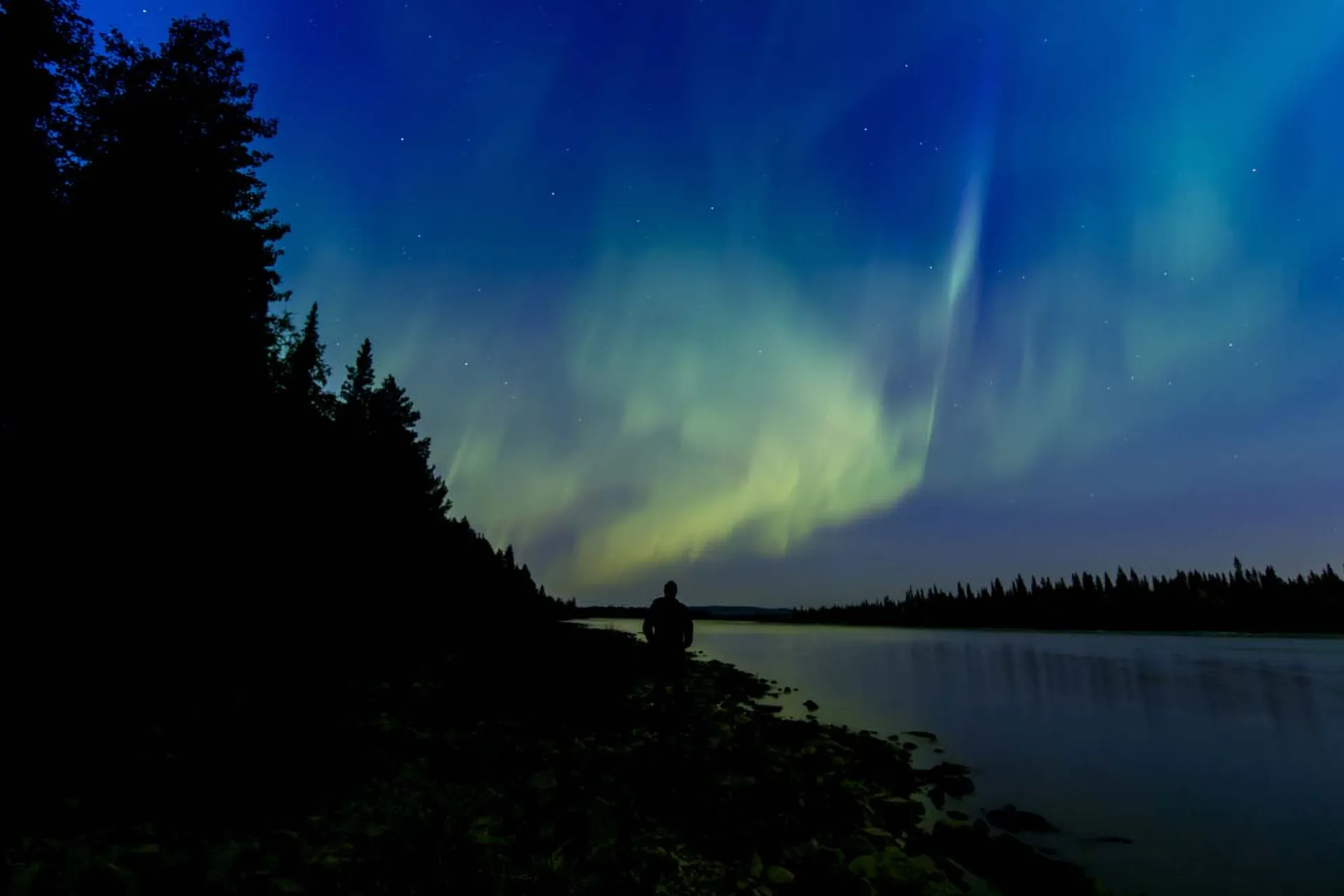
The midnight sun and the Northern lights - The other half of the year
The midnight sun and the northern lights are, in a sense, the same phenomenon viewed fom opposite ends of the year.
Both are caused by the same axial tilt that makes Jukkasjärvi so extreme in each direction. In winter, the tilt sends the sun below the horizon for weeks at a time, producing the polar night called kaamos and the darkness required for the aurora to be visible. In summer, the same tilt keeps the sun above the horizon continuously. The same location, the same latitude, produces both.
They do not overlap. The aurora requires darkness. Between late May and mid-July, there is no darkness in Jukkasjärvi and no aurora. Between September and March, there is darkness and the aurora is visible, but no midnight sun. Many guests who visit once in winter visit again in summer and vice versa. The two experiences are not interchangeable: They are the same place in completely different states of being.
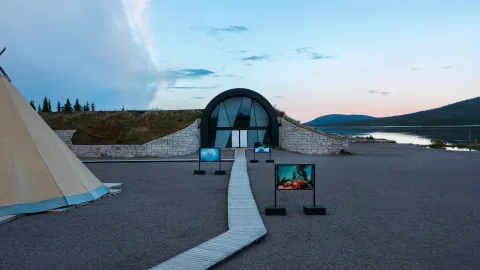
The midnight sun in Sweden - Jukkasjärvi and Swedish Lapland
Sweden's contribution to the midnight sun is a specific landscape: The birch forests and fell plateaus of Swedish Lapland, the Torne River Valley and the network of small communities above the Arctic Circle that have organized their lives around the extreme seasons for centuries.
Jukkasjärvi is the most specific point within this landscape. A village of fewer than 1000 permanent residents, 17 kilometres from Kiruna, 200 kilometres above the Arctic Circle. It is where ICEHOTEL has stood since 1989, rebuilt each winter from Torne River ice and snow and since 2016 kept open year-round in its permanent form, ICEHOTEL 365.
The midnight sun season is when the hotel's least obvious contradiction becomes most visible. ICEHOTEL 365 is kept at a permanent -5°C through the summer using solar energy generated by the midnight sun shining outside. The sun outside powers the ice inside. Guests step from sunshine outside, into a a building filled with river ice, have a drink in a glass made of ice at the ICEBAR and then spend the night in a sculpted suite at -5°C, all while the summer sun continues overhead.
It is genuinely surreal, in the way that the best travel experiences always are: Not because someone designed it to feel that way, but because the place actually is that unique.
For the full picture of what Swedish Lapland offers across both seasons, read the destination guide.
Experiencing the midnight sun at ICEHOTEL
The summer season at ICEHOTEL runs from late May through August, covering the full midnight sun window and the extended midnight light period on either side of it.
Summer activities are built around the light and the landscape it reveals. The Torne River, which in winter is frozen solid, its ice used to build the hotel, runs cold and clear in June. Almost every notable summer activity involves it in some way: Rafting through its rapids, fishing its grayling runs, paddling its calmer stretches.
Off the river, the options include guided hikes around Jukkasjärvi, the Wilderness Dinner served outdoors at a wilderness camp, the Challenge Park among the treetops, year-round ice sculpting at -5°C in ICEHOTEL 365 and the ten-step Jukkasjärvi Sauna Ritual that includes a plunge ingo the Torne River.
The summer packages combine accommodation in ICEHOTEL 365, food experiences and selected activities into a two or three-night stay. They are the most efficient introduction to what the midnight sun makes possible here.
What to do under the midnight sun
Frequently Asked Questions
- What is the midnight sun?
-
The midnight sun is a natural phenomenon in which the sun remains above the horizon for twenty-four hours or more, occurirng above the Arctic Circle during summer months. It is caused by Earth's axial tilt of approximately 23,4 degrees, which keeps the Arctic region in continuous sunlight around the summer solstice.
- Where can you see the midnight sun?
-
Above the Arctic Circle in Norway, Sweden, Finland, Russia, Iceland, Canada, Greenland and Alaska. The further north you are, the longer the midnight sun period lasts. In Jukkasjärvi, Sweden (67°51'N), it lasts approximately 47 consecutive days.
- When is the midnight sun in Sweden?
-
In Jukkasjärvi and the Kiruna area, the midnight sun runs from approximately May 27th to July 14th. The peak is on the summer solstice, around June 21st. Before and after these dates, the sky remains bright through a twilight phenomenon called the midnight light, meaning Jukkasjärvi has roughly 100 days without real darkness each summer.
- How long does the midnight sun last?
-
It depends on latitude. At the Arctic Circle itself, the midnight sun lasts approximately one day around the solstice. In Jukkasjärvi, it lasts approximately 47 days each year. At the North Pole, the sun stays above the horizon continuously for roughly six months.
- What is the difference between the midnight sun and the midnight light?
-
The midnight sun means the sun does not set at all, it remains above the horizon even at midnight. The midnight light (white nights) means the sun dips just below the horizon but the sky stays bright, the sky never reaching true darkness. Both occur in Swedish Lapland: The midnight sun from late May to mid-July and the midnight light extending the bright-sky period from late April to late August.
- Can you see the midnight sun in Iceland?
-
Reykjavík sits just south of the Arctic Circle, so it does not experience the midnight sun in the strict sense. The sun dips briefly below the horizon around the solstice, producing a bright twilight rather than true polar day. To see the genuinely above the horizon at midnight, you need to be in Northern Iceland, or further north, in Sweden, Norway or Finland.
- Does the midnight sun affect sleep?
-
Yes, light suppresses melatonin production, the hormone that signals sleep. Without darkness, the body's usual sleep-wake cues weaken. Most visitors find they sleep less than usual for the first few days. Good blackout urtains help significantly and all warm accommodation at ICEHOTEL includes them.
See also: Midnight in Sweden - When, where and what to expect | Midnight sun activities in Jukkasjärvi | The northern lights at ICEHOTEL | Summer at ICEHOTEL